Develop core expertise in fundamental principles of electrical engineering with specific focus on the areas of control systems, signal processing and optimisation that underpin modern autonomous systems in applications from robotics to UAVs.
Teaching team
These are the lecturers who guide you through the subjects and context bespoke to this specialisation. They are part of the greater teaching team who you meet along your journey through the foundational subjects, your chosen electives, and your capstone project.

I am excited to see this specialisation, that builds on the strong fundamentals that underpinned my own education at the University of Melbourne. It will enable future graduates to contribute to the design and development of autonomous systems, such as those found in irrigation canals, that are becoming increasingly ubiquitous. Dr. Adair Lang, Innovation Manager, Rubicon Water
Structure
The following table lists the subjects required to achieve the Autonomous Systems Specialisation of the Master of Electrical Engineering degree. The table shows the suggested order of taking the subjects, with start and mid-year entry possible. Based on your bachelor's degree, you may be awarded advanced standing for the subjects grouped under Year 1, or part thereof.
The program shown in the table above is built up of the following parts:
- Sixteen foundational subjects that are core to all specialisations of the degree. The foundational subjects are the eight subjects taken in Year 1 and Year 2 which together provide you with a solid foundation from which to specialise.
- Four core subjects that are bespoke to achieving the chosen specialisation. These subjects build upon the foundations of electrical engineering.
- An individualised capstone project that is an outlet for all the expertise you have developed.
- A subject that focuses on professional skills development.
- Two elective subjects to explore your interests and develop expertise across any of our specialisation areas.
Core subjects
The following explains how the topics covered in these subjects are synchronised to develop your autonomous systems expertise.
Autonomous systems are systems that accomplish tasks in their environment with minimal human involvement. They interact with the physical world using both analogue and digital devices to sense their current state and compute control actions. Driverless cars, drones and smart buildings are all examples of autonomous systems. To achieve their goals, they rely on sensing, control, computing, hardware, and software. To fully understand autonomous systems, we need to understand the fundamental ideas behind these concepts.
The subjects Foundations of Electrical Networks, Electrical Device Modelling, Electrical Network Analysis and Design, and Electronic System Implementation prepare us for modelling, analysing, and designing the analogue components of autonomous systems. The subject Digital Systems captures the digital aspects of autonomous systems. To interact with the environment, autonomous systems need to sense their surroundings. However, sensor signals are always corrupted by interference or random noise. To “clean” them up, we need to use powerful techniques from Signals and Systems, Signal Processing Probability and Random Models, and Advanced Signal Processing. To fully understand these topics, we also need some important mathematical ideas that are covered in Engineering Mathematics . The cleaned and processed data is then used to “close the feedback loop”. This is where the autonomous system uses the sensor measurements to compute how it should take control actions to achieve its goals, despite noise and uncertainty. We learn about feedback loops in Control Systems and Advanced Control Systems.
All the elements from the previous subjects come together in Embedded System Design and Autonomous Systems Clinic. These are project-oriented subjects that cover the modelling, analysis, design and building of our very own autonomous systems! Doing a full year Engineering Capstone Project involving autonomous systems consolidates our learning.
Capstone project
Core to all specialisations is the year-long capstone project that is completed in teams of 3 or 4. Through the capstone project you and your team develop solutions to an unsolved problem. The project is tailored to your interests, ranging from: research and development projects proposed by our world-class academics; to multi-team projects that partake in international and local competitions; to innovative projects proposed by you. See the handbook entry for further details.
Professional skills subject
To develop and strengthen the skills necessary to operate as a professional engineer upon graduation, you will take the following subject:
Interdisciplinary Design for Engineers (ENGR90051)
In this subject, students will actively engage in an interdisciplinary, collaborative and project-based learning environment, offering insights into the professional nature of engineering work. Through a real-world project, students will gain hands-on design experience addressing a complex challenge. The project will require students to integrate discipline knowledge and apply professional skills like teamwork and communication.
Elective subjects
To obtain the degree with a specialisation, students must also complete 25 credit points of Electrical Engineering Elective (Group A) subjects (Business specialisation only) or 25 credit points of Electrical Engineering (Group A) or Approved Elective (Group B) subjects (for other specialisations other than Business).
A full list of Electives (Group A) and Approved Electives (Group B) can be found in the handbook entry for the Master of Electrical Engineering.
Master of Electrical Engineering handbook
Where can this specialisation take me?
There are autonomous systems operating in virtually all industries and many aspects of our daily lives, and all those applications require your specialist skills to engineer solutions that meets the demands of now and the future. As one concrete example, this article describes the collaboration between researchers and engineers from the Department of Electrical and Electronic Engineering and Rubicon Water that developed a distributed feedback control system for reducing water loss from irrigation, achieving a 50% reduction! This represents a significant contribution to improving the health of our waterways and sustainability of our farming practices.
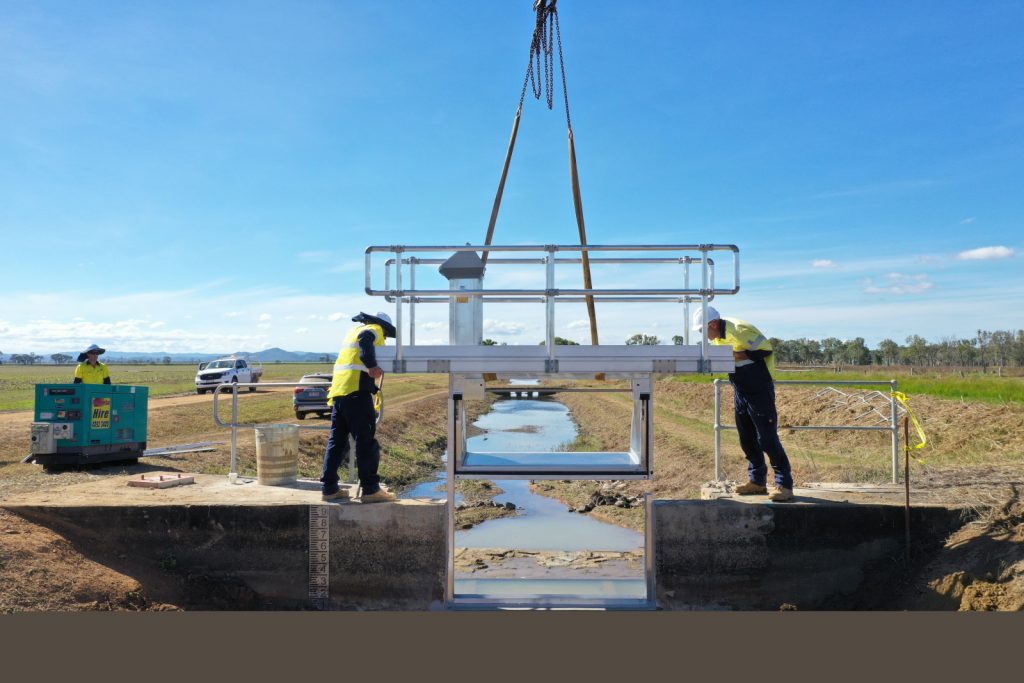
Image © Rubicon Water
Sample course plan
See the sample course plans on the University of Melbourne Study page for more details.